



The mobile application has become one of the most important—and exposed—parts of the digital enterprise. For banks, fintech companies and other digital businesses, it is no longer simply another customer channel. It is where users authenticate, transact, share sensitive information and increasingly establish their digital identity.
That shift has changed the security challenge. Organizations may have mature controls around networks, servers and cloud infrastructure, yet much of what happens on a customer’s device remains outside their direct control. Once an application is released, it operates in an environment where attackers can study its behavior, attempt to reverse engineer it, manipulate its runtime environment or exploit the device around it.
But there is another problem that receives less attention: security that is technically strong can still fail operationally.
When protection creates excessive false positives, affects application performance or blocks legitimate users, the consequences quickly move beyond the security team. Customer complaints increase. Support teams become involved. Product and development teams push back. Eventually, controls may be relaxed to restore the user experience. At that point, an impressive security capability can become far less effective in practice.
This is why the next stage of mobile security should not be measured only by how aggressively a system can detect threats. The more important question is whether protection can remain effective, usable and continuously deployed as the application, users and threat landscape evolve.
Context Matters More Than a Single Signal
Traditional security decisions can become too binary. A rooted device is detected, so access is blocked. A debugging tool appears, so the session is rejected. These signals can certainly indicate risk, but viewed individually they do not always tell the full story.
A more sustainable approach is to consider multiple signals together. A rooted device alone may have a legitimate explanation. The same device displaying evidence of a hooking framework, screen manipulation and suspicious activity during a sensitive transaction represents a very different risk profile.
This shift from isolated detection toward contextual, multi-signal analysis can help security teams respond according to the level of risk rather than treating every anomaly as an attack. Low-risk activity may warrant observation or a warning; higher-risk combinations may justify restricting or blocking an action. The objective is not weaker security. It is more precise security.
The Device Is Becoming the Fraud Battlefield
Server-side fraud controls have become increasingly sophisticated, but attackers are also moving closer to the user. This, along witht he advancement of AI which speds up the attacks. Malware can abuse accessibility services, capture screens, intercept information, manipulate applications or operate inside compromised device environments. From the server’s perspective, a transaction may still appear legitimate because authentication has succeeded and the expected account and device information is present.
This creates an important visibility gap. It also means mobile application security should not operate as an isolated technical control. Device intelligence, application protection, fraud monitoring and identity signals are more valuable when they can inform one another and give security teams a clearer picture of the circumstances surrounding a transaction. Organizations need to understand not only whether a user has authenticated successfully, but also what is happening around the application at the moment a sensitive action takes place. Runtime visibility on the device is therefore becoming an increasingly important complement to traditional fraud, identity and server-side security controls.
Artificial intelligence is accelerating this change on both sides. Attackers can use automation to modify malware, scale attacks and create increasingly convincing synthetic content. Defenders, meanwhile, can use behavioral analysis to identify unusual patterns that would be difficult to capture through static signatures or manually maintained rules alone.
The lesson is broader than simply adding AI to security products. Threats are becoming more dynamic, which means defenses also need to become more adaptive. Security architectures designed around fixed indicators and periodic updates will increasingly struggle against attacks that change rapidly.
Security, Performance and Experience Must Coexist
Mobile security ultimately operates inside a three-way tension: security, application performance and user experience. Maximizing one without considering the others is rarely sustainable. Very aggressive controls may improve theoretical protection but damage usability. Prioritizing frictionless experiences without sufficient protection creates obvious security exposure.
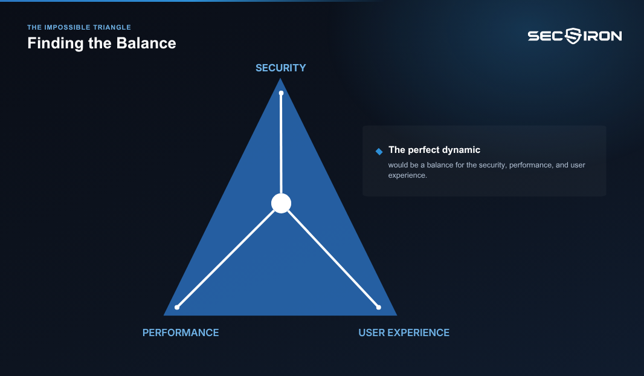
There is no permanent setting that solves this balance. Applications change, operating systems evolve, customer behavior shifts and attackers develop new techniques. Organizations therefore need layered controls, contextual decision-making and the ability to adjust responses as risk changes.
For security leaders, this changes the question from “How many threats can we detect?” to “Can we maintain strong protection without disrupting the digital experience our customers depend on?”
The strongest mobile security strategy will not necessarily be the one that generates the most alerts or blocks the most devices. It will be the one that provides meaningful protection throughout the application’s lifecycle, gives organizations visibility into threats occurring on the device, adapts as attacks evolve and remains operational over the long term.
Because ultimately, security only protects the business when it stays on.